An initiate's guide to the Cassette
Fri May 01 2026
Tags:
tech
featured

With the popularity of physical media on the return, you might be thinking of getting into tape as a medium. Maybe you are like me who inherited a bunch of tapes, or you really want to make a mixtape or have some superficial aesthetic inclinations, or think it’s just.. neat. This write up is dedicated to honestly explaining the state of cassette as a medium, and how to start your collection and make mixes if you so choose that path.
Physical media revival is in its bulk about CD and vinyl. Though tape does get attention, it has unique problems that the other two simply don’t (which I will discuss shortly). One notable thing about tape is, unlike its brothers, the audio quality is just not great and sometimes unacceptable in light of the digital standard we have accustomed to. It can be under specific set-ups and circumstances, of course, but its ubiquity, price and ease of portage outclassed quality in its lifetime. This can be a boon if you are after a lo-fi feel that can be subjectively nice, and Eno says-so: “Whatever you now find weird, ugly, uncomfortable and nasty about a new medium will surely become its signature.”
It is also comparatively cheap (or should be still), which can be a reason to get into it over the others. It is also portable and compact, but CDs, Minidisc, and MP3 players are far away kings in that space if you are OK with digital formats. The tactile feel of cassette is a great one, though, and less expensive than that of vinyl by a mile. Before I get too ahead of myself selling you on this, I need to crush your hope in the medium just a bit and explain the problem with cassette as a medium and possible hurdles you will face and doom later down the line.
Problems, Concrete and Existential
The Problem
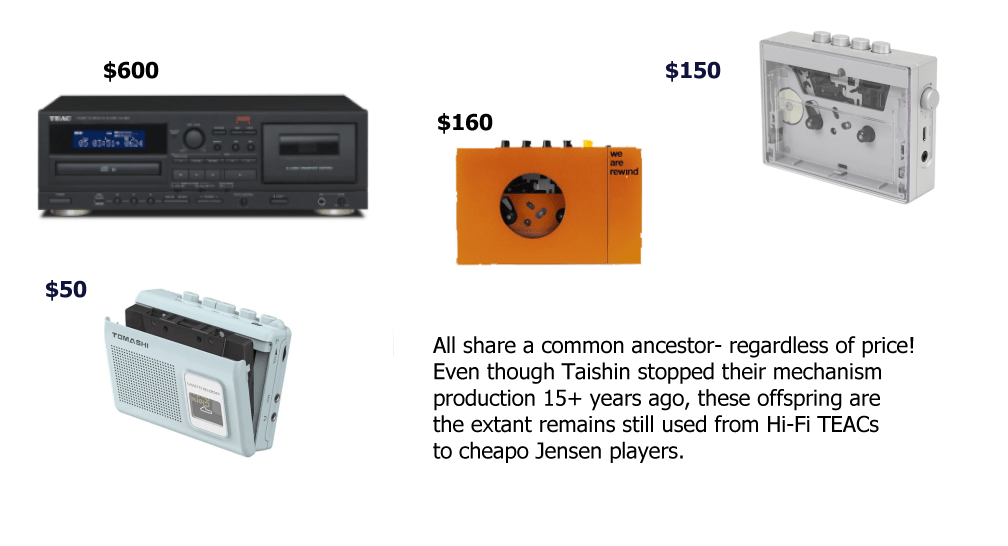
Cassette has what I’d call a Roman concrete problem: the old stuff was just made better, and there’s a loss of technology rather than gain over time. Modern tape mechanisms and tapes themselves are pretty bad, and tech like sound reduction is not used anymore, since they were Dolby’s tech (if you want to see the jokes they’re up to now, check out Dolby Atmos). While new machines are available, everything from the 40$ Jensen off amazon to the 200$ WeAreRewind to a 400$ TEAC deck is using the same similar mechanisms cloned off one Tanashin mechanism, discussed here.While some have better parts and pieces, the core mechanism is just not to par with the old stock. And don’t bother with those novelty nostalgia-sapping gadgets like the Rewind who claim they’ve somehow innovated. You are better off finding something older if possible. This is less of a problem for CD and vinyl users, with vinyl having tons of high quality modern options that take the whole comeback more seriously. It also means you have to be willing to look after your tech as wear and tear does happen. I will talk about buying and servicing machines in a bit, but let’s talk about a second problem…
.. the tapes themselves. There are 3 main types of cassettes. From least to best quality, there are Type 1 ferric, Type 2 CrO2 and Type 4 metal. If you buy new blanks or a new commercial album, you are probably the proud owner of a Type 1 tape. Buying secondhand blanks of Type 2 and Type 4 can run you serious money, as new ones haven’t been made in a long time. One metal tape, for instance, who was always expensive at retail, can be 30–40$ on eBay. Pre-recorded older tapes tend to also be Type 1, but you’ll see some chrome ones frequently. One thing about modern vs. old pre records is, of course, that new ones don’t use noise reduction. From the 70–90s, some different kinds of this tech were put out by Dolby, with Dolby B being the most widespread. Playing these tapes nicely is no problem, provided you have a dial to enable NR if you want to take advantage of that. Throwing NR enabled might make the sound better or worse on a capable tape and just worse on one who doesn’t have it, so it’s up to you.
The pain of new stock
To me the lack of NR is less of a problem than the inconsistent quality of new cassette releases. I have some that sound really nice and some that sound surprising.. bad. Smaller presses who work in the medium honestly and underground genres native to the medium are more consistent, but big labels and releases put much less effort in. Consider: does a 30$ fucking Benson Boone tape or a 10$ underground electronic or thrash tape? My money is literally on the latter. Anecdotally, Bjork’s limited cassette of Post sounds flat and boring, while (frequent cassette releasers) Deaths Dynamic Shroud’s limited Darklife sounds lush. You can find plenty of talk online about this as well, so there’s a buyer beware about all physical new releases that apply hard to cassette.
So cassette has some caveats. Consider: do you listen to a genre popular in cassette form, such as old-school hip hop, metal, or new wave, or plan on recording yourself? If yes, then cassette might be a good fit. If you listen to more mainstream modern releases, CD or direct download is a better fit for you. With how poor the modern cassette tech is, the increasingly unrealistic price of some mainstream labels put on cassettes (30 dollars!?) the allure is not worth it. With you warned, we can move on to how to actually get into cassettes: buying, servicing and recording.
A short buying guide..
So you’ve decided to get into cassette. There are two player categories, which are decks and portable (walkmans… walkmen?). Think about your use case, if you plan on playing only and bringing tapes with you? A Walkman. Want to do nice quality recording? A deck with three heads is good. Want to duplicate or switch between 2 tapes automatically? Decks with two slots are common and can be used for this. There are several qualities to keep in mind as standard:
- - Can play at least Type 1 and 2 tapes and has basic controls, including star/stop and rewind/fast-forward. Auto reverse is also nice to have, especially on decks.
- - For decks: have it be a stand alone (not part of an all-in-one). For portables, avoid new ones and stick to major older brands if you want quality.
- - For decks: Dolby B and C slider, especially if you have old pre-records.
Servicing the tech
Audio repair shops that will deal with cassette decks and walkmen do exist. But I think they are far between outside of cities: I recommend looking up somewhere local if you really need a serious repair. But much of the servicing might have to be done by you, and secondhand finds might need a tune-up right away if someone hasn’t done you the favour ahead of time. I’m just assuming you have no specialized equipment, as I do not, and covering what’s in our scope.
Heads will Roll (Cleanly)
This is pretty boring. You should swab down the rollers, capstan and tape heads down with 99% alcohol. Yet, I attempted to record a tape twice, ending with completely muffling before doing this… grime and dust build freely in units, It’s good to swab it down, including the rollers in particular because gnarly old tapes are probably mucking them, priming them to eat the next tasty tape on the way. All these components are easy to access in the tape compartment with no disassembling so no excuses not to!
Wow, Does it Flutter
Wow and Flutter: words that sound like how they’re spelt. When does this become a problem? When you notice it basically. The dedicated user will check with a Wow and Flutter tape (can be store-bought or homemade) and WFGUI. Cool now you know for sure there’s wow and flutter. The causes are varied, from the tapes used themselves, to your motor and plain old bad hardware decisions. Most curable at home and likely on old and unserviced decks: your belts need changing.
The Belt
The belt is pretty crucial and service manual in hand, you can find your needed belts online. Some sites even list belts by model for you, like WebSpareParts, and there is always eBay. You might have to measure the existing belts themselves if it’s really obscure to find real info on your unit. Measurements can be used to find matching belts by size on vintage-electronics.net. Careful with the mix packs off cheap places, you might get new problems and solve little.
Before at all touching anything inside the deck when changing belts, please do what I did not and take a photo of the belt layout. Manuals often might not have good photos on what they’re supposed to be arranged like. You can reference them when switching out the belts. See if there are YouTube videos by others on your particular unit you can follow or a general guide before wire-goring your device.
If your wow and flutter keep at it despite trying everything, you might just have some motor issue that needs servicing and its time to turn to someone who knows their way around finicky issues.
A What?: The Azimuth
What does the horizontal angle in a spherical co-ord system have to do with cassette repair? A little. The azimuth is that horizontal angle applied in this case to the head of your player in relation to the tape, and the alignment of this will impact the quality of the sound. A misaligned azimuth is best corrected through judicious use of an azimuth aligning test tape and several gadgets. Assuming you don’t give enough of a shit, you can also mess with the head’s screws to realign it to your liking and check the levels with an oscilloscope app. This guide will suffice.
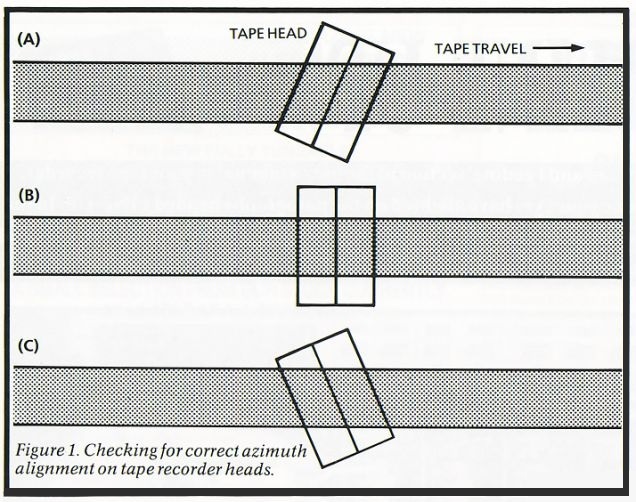
Careful with magnetic stuff, though, avoid bringing it around your set. Actually, a secret fourth point is you might want to use a demagnetizer, although it seems no one can agree on it so YMMV: If you can’t help but stick magnetic things near your tape heads, often then consider a de-mag wand or tape.
This section is pretty boring by necessity, but it means we can finally get on to some fun.
Actually Playing, Recording and Using.
My two tape players are a 1) Yamaha KX-W262 dated to 92-ish. It has two sides for play but only one record, also meaning it can dub. It auto reverses and switches from sides a and b so you can run out 2 tapes handless. The counter is broken but everything else is strikingly in form. The other is a portable Aiwa HS T50 from around the same time that has a working radio.
My set up is pretty simple. The deck is attached to powered speakers, which you can find cheap and dubious at thrift places or cheaply from a brand like Edifier. If you do not plan on having a full hi-fi stack, with an amplifier for unpowered speakers, this is your best and cheapest option, as it’s essentially plug-and-play. It’s less fancy and cool. Sure. But be honest, are you gonna buy a vintage receiver for 300+ dollars before you get a sound out of your machine? Keep it simple silly.
My own recording set up is simple but involves a device repurposed from my computer: a DAC or a Digital to Analog Converter. This nifty device is paired with my headphone amp usually, but serves to more nicely record than use a weird amazon cable I fished up. These things go for $20 to $2000, but mine is an entry-level device from schitt I bought in high school and its held up for many years of perpetual use, so for $120 bones, its a great omni-use DAC. (Review Note: recently it has begun to die, and needs a dousing of a hair dryer to get it going or abt 20ish minutes of simmering time..)
Aptly, it will take a USB in to your PC and RCA outs in the back that I plug in to the input of the deck. I load my preassembled mix into audacity, hit rec/pause and hit play when I want to start recording in real time. Make sure your recording level is nice before you record a whole tape by just doing a little and rewinding, then recording over again. No harm no foul. Please let a few seconds pass on the tape before starting the tape recording so it doesn’t clip, and you will likely have and really should flip the sides at the mid mark yourself. That’s kind of it.
When it comes to mixtape making I like to go full on and design little J-Cards. I have experimented with glueing labels on the cassettes themselves but id not advise that. For J-cards and obis I use the templates found on duplication and print my own on printer or passably thin card stock. Several ones I’ve made over the years I have given away (a joy of cassette mixes) and some I have on hand as examples. See below for some card art.

I did not bring my clunky setup with me on my move for school, so I’ve been missing the fun of cassettes. If you are also a semi-portable person like me now, a walkman can be nice to scratch the itch, and taking a couple tapes doesn’t ruin storage space too bad. They come in a pretty hardy case and won’t warp as brazenly as their format peers.
Collectors Market
The best part in the end is getting to collect music you like in the format of your choice, and for me cassette has been pretty great at that. If you enjoy travel, especially international (or have friends who do or live away from you), consider perusing the local selection. You may or may not be surprised by what stock they carry and how much investment into cassette existed and still exists in the world. I have many bizarro and non catalogued Korean and Chinese albums for instance. You might stumble upon local releases by some hardcore or synth band. Skeevy stores will sell you a bootleg of C148’s minecraft music for 20$ and then let the good real stuff under their nose for half that. A nice aspect: you realize patterns and a cadence to a market. Where I live, you see the same tapes again a lot. Popularity? Lack of popularity? Who knows! And like books, inheriting part of someone else’s collection can tell a story: liner notes, custom mixes, clear favourites. You will have elusive wants to keep an eye out for, and elusive wants that are hundreds of dollars on discogs. It is all part of the game.
Well theres not much extra to say– I hope you enjoyed my brief rant/guide on the subject. I think cassette is still a pretty accessible and underrated format and worth getting into!
